How it works
Rolled into place. Lined up by laser. Closed from a phone.
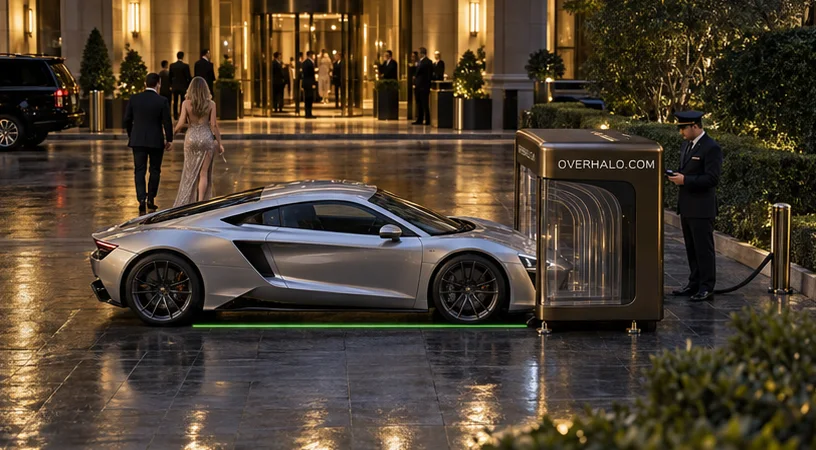
Each Pod lives at a venue, retracted into a slim bronze box and plugged in. When a guest asks for one, the valet rolls it to the parked car on its powered wheels, lines it up by laser, locks its wheels and deploys it — all from the valet app.

Arrival to departure
Every step, from both phones.
-
01
Park and request
The car is parked at the showcase spot. The guest taps Request a Pod in the OverHalo app.
-
02
The valet accepts
The request lands in the valet app. The valet rolls a Pod out on its powered wheels, driving it from the phone at walking pace.
-
03
Lined up by laser
The Pod projects two green laser lines along the ground either side of the car. The valet steers it until the app shows the car centred, then the Pod’s wheels lift and lock.
-
04
Closed, sealed, locked
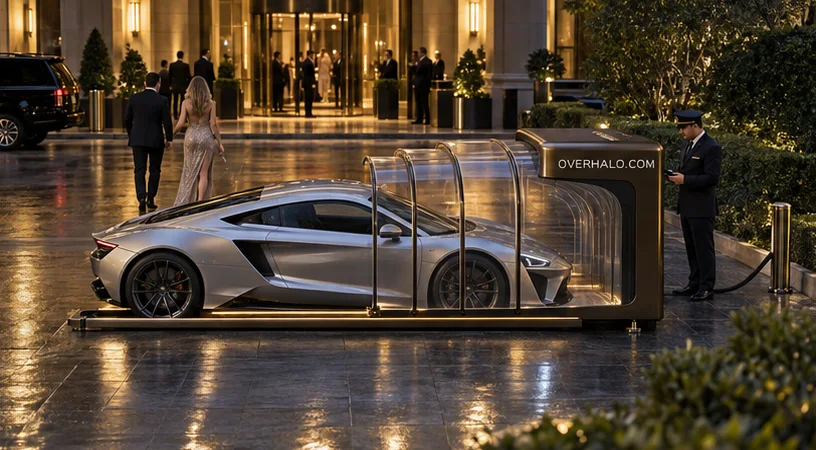
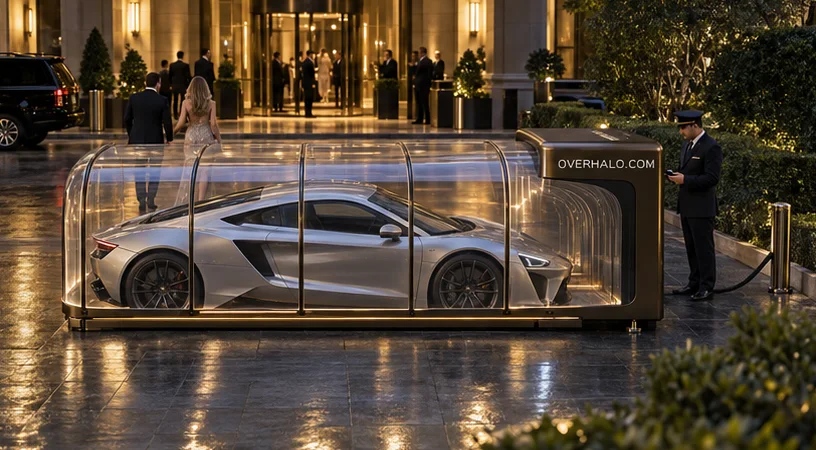
The valet holds Deploy: rails out along the ground, the clear shell closes over the car, the end wall seals and every joint locks by itself. About ninety seconds. The climate system starts the moment it is sealed.
-
05
Billed in the app
$100 an hour, three-hour minimum, plus the valet’s 20% gratuity, charged in the app when the guest leaves. The payment splits automatically.
-
06
On the way out
The guest taps Bring my car. The valet retracts the Pod from the phone, unlocks its wheels, rolls it back to its bay and brings the car round.
The mechanism
Everything comes out of the box.
Rolled into position
Four powered, steerable wheels. The valet drives the Pod from the app at walking pace; sensors stop it short of people and cars. At its spot the wheels lift and lock and it stands on its feet.
Lined up by laser
Two green lasers draw lines on the ground exactly where the rails will run. The valet steers the Pod until both lines sit evenly either side of the car; Deploy stays locked until it is centred and the wheels are locked.
Rails along the ground
Two low rails telescope out of the box either side of the car, resting on the ground along their whole length. Sensors stop them 50 mm from the bodywork. Nothing ever goes under the car.
Closes and locks itself
Rigid segments of hard-coated polycarbonate on bronze aluminium hoops slide out over the car, the end wall drops and seals, and every joint locks automatically. It reads like glass and is far tougher than glass.
Walls that rise and fall
Each segment’s side walls telescope so the roof sets itself 15 cm above the car — a mid-engine supercar or a full-size SUV. Only the segments the car needs are deployed.
Fed from behind
A 240 V supply comes from behind the Pod into an inlet on its back, so no cable ever crosses the space. A backup battery covers moves and power cuts.
Climate, in action
Cooled, warmed, vented and circulating.
Every Pod carries a heat pump — air-conditioning in summer, heat in winter — with filtered fans drawing air in low and out at the crown, and dew-point control keeping condensation and frost off the paint and the glass. There is never an engine or a generator in or on a Pod.
- Centred on the lasers
- Wheels locked
- Nobody inside
- Shell closing
- End wall sealed
- Every joint locked
- Climate on
Safety
Built like an automatic gate, because it moves near people.
The rules that apply are the ones for powered gates and doors — UL 325 in North America and EN 12453 in Europe.
Nobody inside
Presence sensing before and during closing, and while closed. Anyone detected inside means it stops, opens and alerts.
Stops on contact
Pressure-sensitive safety edges on every moving edge. Touch one and the motion stops and reverses.
Opens without power
A manual release inside and a valet key outside.
Anchoring and wind
Locked to the ground at its spot.
At each showcase spot there are four flush anchor sockets in the paving, installed with the power supply. The Pod’s feet lock into them when it stands, so it is fixed to the ground with nothing visible when it is rolled away.
It will not start closing in strong wind, when the moving segments are most exposed. Once closed and locked it is designed to stay closed through a storm.
OverHalo is in development. Wind and temperature figures are engineering targets until tested, and we do not claim any hail or theft rating. What we claim.